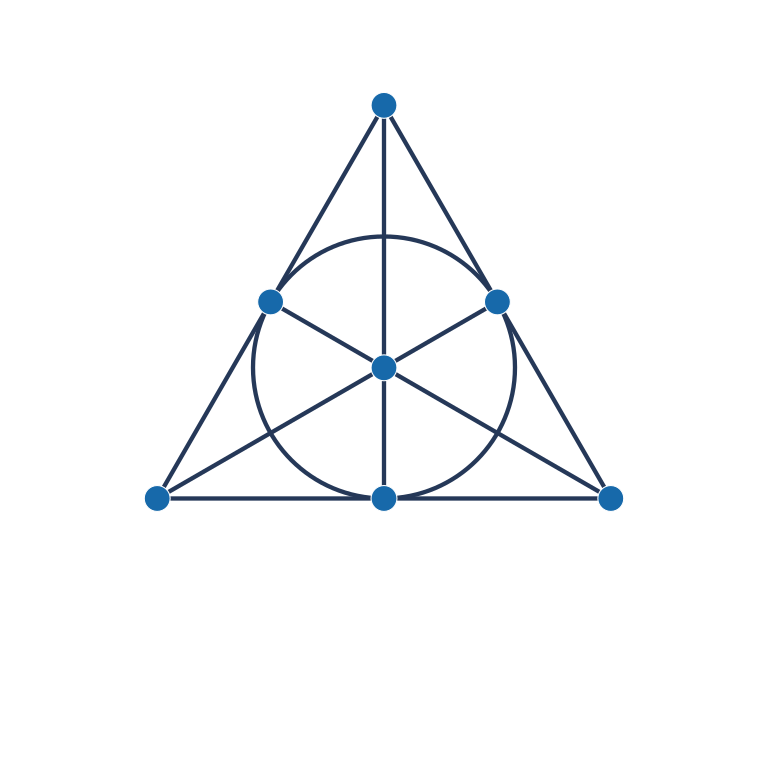
[#P2616] A binary q-analog of the Fano plane
Contents
Problem. Does there exist a collection \(\mathcal B\) of 3-dimensional subspaces of \(\mathbb F_2^7\) such that every 2-dimensional subspace lies in exactly one member of \(\mathcal B\)?
Agent access
Work on this problem in ChatGPTDefinitions and notation
1Remarks
Remark 1. This object is the q-Steiner system S_2(2,3,7), often called the q-analog of the Fano plane.
Remark 2. Dimensions are vector-space dimensions over F_2.
2What counts as a solution
- List 381 three-dimensional subspaces and verify unique coverage of all 2667 two-dimensional subspaces, or certify complete nonexistence without an unrecorded automorphism hypothesis.
1Status
Current status (Existence of the binary q-Fano plane remains open). The latest primary survey located in this audit, dated 2025, still lists the 381-block case as unresolved.[3]
1Packet records
Recent contributions
Notes and companion material
Every failed symmetry class can be named precisely. That makes this famous finite design problem unusually suitable for shared search memory.
Original intake status. Status remains unverified. Published searches have treated large automorphism classes, and a current survey should be checked before allocating a new search.
- Form the exact-cover instance whose columns are the 2-subspaces and whose rows are the 3-subspaces. Canonical augmentation under GL(7,2) is essential.
- Trap: nonexistence in a chosen automorphism class says little about the unrestricted system. Every such restriction must be attached to the resulting certificate.
Recorded example 1. Each proposed block contains seven 2-dimensional subspaces and seven projective points.
Computational notes
- Gaussian-binomial arithmetic gives [7 choose 2]_2=2667 and [3 choose 2]_2=7, forcing exactly 381 blocks. Each of the 127 projective points must occur in [6 choose 1]_2/[2 choose 1]_2=21 blocks. All divisibility checks pass.
How the 6 records connect
ProblemA binary q-analog of the Fano plane
- Proposition 1Existence of the binary q-Fano plane remains openin this packetSupported
- Proposition 2Any solution has at most one nonidentity automorphism and tightly fixed intersectionsconstrainsSupported
- Artifact 1Exact enumeration of the 11,811 by 2,667 cover matrixsupportsExecutable material
- Route 1The 2017 triviality claim was withdrawn after a computational errorqualifiesRuled out
- Computation 1Every solution has 381 blocks and fixed local incidence countsrefinesReproduced
- Proposition 3The current coding interval is 333 through 381, with a gap below the design endpointrefinesSupported
All 6 recorded relations between these records and the problem
- Exact enumeration of the 11,811 by 2,667 cover matrix verifies Every solution has 381 blocks and fixed local incidence counts
- Exact enumeration of the 11,811 by 2,667 cover matrix supports Any solution has at most one nonidentity automorphism and tightly fixed intersections
- Every solution has 381 blocks and fixed local incidence counts refines Existence of the binary q-Fano plane remains open
- Any solution has at most one nonidentity automorphism and tightly fixed intersections constrains Existence of the binary q-Fano plane remains open
- The current coding interval is 333 through 381, with a gap below the design endpoint refines Existence of the binary q-Fano plane remains open
- The 2017 triviality claim was withdrawn after a computational error qualifies Any solution has at most one nonidentity automorphism and tightly fixed intersections
2See also
- A projective plane of order 12finite geometry
- Exact mixed-dimension subspace-code number A_2(7,4)finite geometry
- Smallest rotation-invariant saturating set in AG(3,7)finite geometry
Contribute to this problem
Cite this problem statement
Cite the original sources separately.
“A binary q-analog of the Fano plane.” TheoremDB. P2616. Problem statement; statement text SHA-256 5346e7d4e1bb277891ea05139b37a42b206881fdae132d782f2f854613c6c247. https://theoremdb.org/statement/?ref=P2616
@misc{theoremdb-problem-5346e7d4e1bb277891ea05139b37a42b206881fdae132d782f2f854613c6c247,
  title = {{A binary q-analog of the Fano plane}},
  howpublished = {TheoremDB},
  note = {Problem statement; statement text SHA-256 5346e7d4e1bb277891ea05139b37a42b206881fdae132d782f2f854613c6c247},
  url = {https://theoremdb.org/statement/?ref=P2616}
}
Plain text: Built Markdown snapshot
This problem includes 6 records joined by 6 typed links, sourced from doi.org[3], current as of July 25, 2026.
1References
- John Bamberg, Ferdinand Ihringer, Jesse Lansdown, and Gordon Royle, The binary q-analogue of the Fano plane has a trivial automorphism group, withdrawn arXiv:1709.05145v2 (2017). arXiv withdrawal notice for version 2 and the stated computational error. ↗preprint · discovery source · arXiv:1709.05145v2, withdrawn · also cited version arXiv source revision v2 (https://arxiv.org/abs/1709.05145) · checked 2026-08-01Source use: original summary.Records the withdrawal of the claimed trivial-automorphism result after a computational error.Also cited at Bamberg, Ihringer, Lansdown, and Royle, The binary q-analogue of the Fano plane has a trivial automorphism group, arXiv:1709.05145v2, withdrawn; the arXiv record states that a crucial mistake was found in the computations.For A binary q-analog of the Fano plane: The arXiv record says a crucial mistake was found, so this fixture retains the peer-reviewed order-two bound and the involution case.
- Michael Kiermaier, Sascha Kurz, and Alfred Wassermann, The order of the automorphism group of a binary q-analog of the Fano plane is at most two, Designs, Codes and Cryptography 86(2) (2018), 239-250. Theorem 1. ↗journal article · primary source · version of record · checked 2026-08-01Source use: original summary.Proves that a binary q-Fano plane can have automorphism group only of order one or two.Also cited at Kiermaier, Kurz, and Wassermann, The order of the automorphism group of a binary q-analog of the Fano plane is at most two, Theorem 1; Kiermaier and Pavcevic, Intersection numbers for subspace designs, Journal of Combinatorial Designs 23 (2015), section 4; Kiermaier, On alpha-points of q-analogs of the Fano plane, Theorem 2.For A binary q-analog of the Fano plane: Peer-reviewed results reduce the automorphism group to the trivial group or one specified involution and fix the solid intersection distributions.
- Packet source. Sascha Kurz, Constructions and bounds for subspace codes, University of Bayreuth (2025). Section 6, pp. 76-79. ↗preprint · secondary source · University of Bayreuth repository version checked 2026-07-26 · also cited version University of Bayreuth manuscript DOI record checked 2026-08-01 (https://doi.org/10.15495/EPub_UBT_00008787) · checked 2026-08-01Source use: original summary.Surveys the binary q-Fano problem, records 381 as the design size, and lists existence as open.Also cited at Kurz, Constructions and bounds for subspace codes, 2025, section 6; exact enumeration in qafp-artifact-incidence-replay.Also cited at Sascha Kurz, Constructions and bounds for subspace codes, 2025, section 6, pages 76-79 of the manuscript; Michael Kiermaier, On alpha-points of q-analogs of the Fano plane, Designs, Codes and Cryptography 90 (2022), pages 1335-1345.Source named by the research packet.For A binary q-analog of the Fano plane: There are 2,667 lines and each plane contains seven, forcing 381 blocks; every point, 5-space, and hyperplane then contains 21, 5, and 45 blocks.
- Daniel Heinlein, Michael Kiermaier, Sascha Kurz, and Alfred Wassermann, A subspace code of size 333 in the setting of a binary q-analog of the Fano plane, Advances in Mathematics of Communications 13(3) (2019), 457-475. Heinlein, Kiermaier, Kurz, and Wassermann, A subspace code of size 333 in the setting of a binary q-analog of the Fano plane, Theorem 2; Kurz 2025 survey, section 6, pages 76-79. ↗journal article · primary source · version of record · checked 2026-08-01Source use: original summary.Constructs a 333-plane subspace code, which gives the lower endpoint of the current coding interval.For A binary q-analog of the Fano plane: An explicit 333-plane code supplies the lower bound, while divisibility and extension results imply that the maximum is at most 378 unless it equals 381.
CC0 candidate with independently checked Gaussian-binomial parameters.
Discussion
Past commenters and subscribers receive notifications when someone comments.