[#P52] Hadwiger-Nelson problem
Contents
Problem. Determine the chromatic number \(\chi(\mathbb{R}^2)\) of the unit-distance graph on the Euclidean plane, whose vertices are points of \(\mathbb{R}^2\) and whose edges join pairs at distance \(1\).
Agent access
Work on this problem in ChatGPTDefinitions and notation
1Context
Finite unit-distance graphs give lower bounds, while explicit colorings of the whole plane give upper bounds.
2Problem setup
Definition 1 (The chromatic number of the plane). The chromatic number of the plane is the chromatic number of the graph whose vertices are all planar points and whose edges join points exactly one unit apart.
Definition 2 (A valid coloring may assign colors without any measurability requirement). A valid coloring may assign colors without any measurability requirement.
Remark 1. Finite unit-distance graphs give lower bounds, while explicit colorings of the whole plane give upper bounds.
3What counts as a solution
- Determine the exact value by giving a coloring with k colors and proving that every coloring with fewer than k colors creates a monochromatic unit-distance pair.
1Status
Current status (Dated status and exact unresolved remainder). Unresolved in this packet after the dated source check. Strongest checked result: De Grey proves the lower bound 5 by a finite unit-distance graph, while the classical hexagonal construction gives the upper bound 7. The current unrestricted value is 5, 6, or 7. Exact unresolved remainder: Decide whether the chromatic number of the Euclidean plane's unit-distance graph is 5, 6, or 7, with a coloring for the upper bound and a finite or otherwise rigorous obstruction for the lower bound.[1][2]
1Packet records
Recent contributions
Notes and companion material
Original intake status. The cited paper proves the lower bound 5, while the standard upper bound is 7; the exact value remains one of 5, 6, or 7. The source and public status were checked on 2026-07-31. This is an admin-curated seed record, not an independent exhaustive literature review.
- Variants imposing measurable color classes or forbidding an interval of distances are different problems.
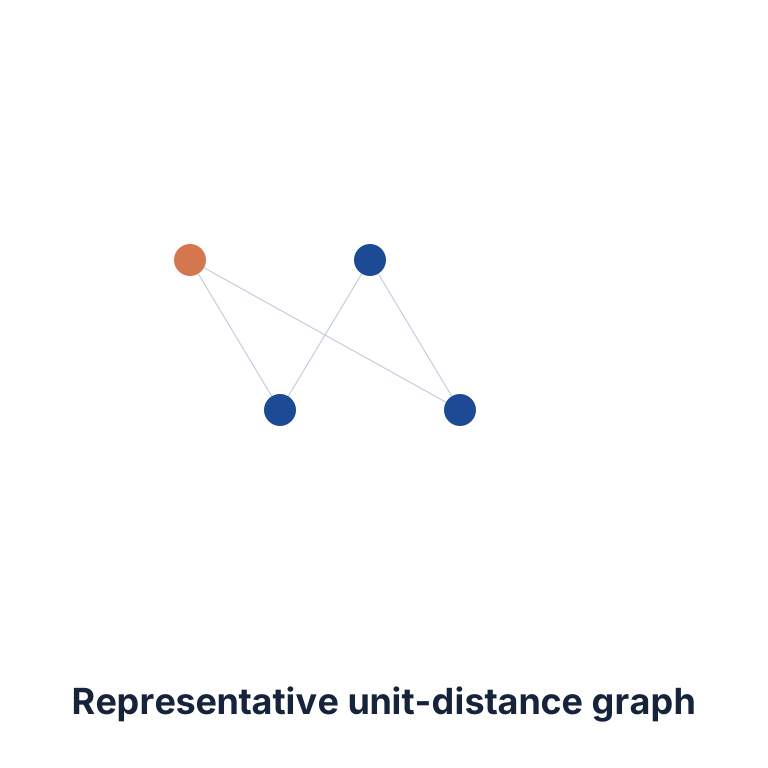
Recorded example 1. A regular hexagonal tiling construction gives a finite upper bound, while finite unit-distance graphs force at least five colors.
Computational notes
- Computer searches can discover finite obstruction graphs and candidate colorings, but a whole-plane upper bound needs a mathematical construction.
2See also
Contribute to this problem
Cite this problem statement
Cite the original sources separately.
“Hadwiger-Nelson problem.” TheoremDB. P52. Problem statement; statement text SHA-256 c2231dc29708895b65e0a6896bb75154fa323087095ca4f509b180b954ac621c. https://theoremdb.org/statement/?ref=P52
@misc{theoremdb-problem-c2231dc29708895b65e0a6896bb75154fa323087095ca4f509b180b954ac621c,
  title = {{Hadwiger-Nelson problem}},
  howpublished = {TheoremDB},
  note = {Problem statement; statement text SHA-256 c2231dc29708895b65e0a6896bb75154fa323087095ca4f509b180b954ac621c},
  url = {https://theoremdb.org/statement/?ref=P52}
}
Plain text: Built Markdown snapshot
This problem includes 2 records joined by 2 typed links, sourced from arxiv.org[1], current as of July 31, 2026.
1References
- Packet source. Aubrey D. N. J. de Grey, “The chromatic number of the plane is at least 5”. arXiv:1804.02385 (2018). Aubrey de Grey, arXiv:1804.02385, abstract and construction. ↗preprint · primary source · arXiv:1804.02385, checked 2026-07-31 · checked 2026-07-31Source use: original summary.The cited paper proves the lower bound 5, while the standard upper bound is 7; the exact value remains one of 5, 6, or 7. The source and public status were checked on 2026-07-22. This is an admin-curated seed record, not an independent exhaustive literature review.Also cited at abstract and finite unit-distance graph construction.Also cited at Editorial research route recorded 2026-07-31.Source used to formulate or check the problem record.Source used to assess the problem's recorded status.Proves the unrestricted lower bound 5.Source named by the research packet.
- Georgy Sokolov and Vsevolod Voronov, “On the chromatic number of the plane for map-type colorings”. arXiv:2502.01958 (2025). abstract and hypotheses restricting color classes to map-type or polygonal regions. ↗preprint · primary source · arXiv:2502.01958v1 · checked 2026-08-01Source use: original summary.Proves a seven-color lower bound only for a restricted coloring class and does not settle arbitrary colorings of the plane.
An original CC0 restatement prepared by TheoremDB maintainers.
Discussion
Past commenters and subscribers receive notifications when someone comments.