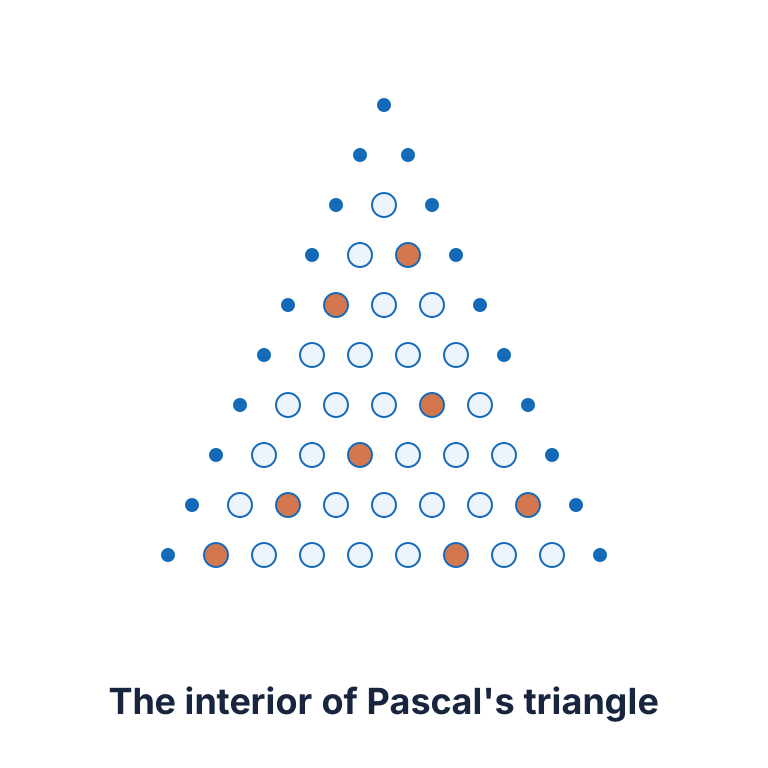
[#P2844] Classify factorials in the interior of Pascal's triangle
Contents
Problem. Determine every triple of integers \((n,k,m)\) with \(n\ge4\), \(2\le k\le n/2\), and \(m\ge2\) such that \(\binom nk=m!\). Prove that the resulting list is complete.
Agent access
Work on this problem in ChatGPTDefinitions and notation
1Context
This elementary-looking classification mixes prime divisors of consecutive products with factorial valuations. Search tables of smooth binomial coefficients and congruence obstructions can be reused as the unconditional cutoff improves.
2Problem setup
Definition 1 (The binomial coefficient). The binomial coefficient is \(\binom nk=n!/(k!(n-k)!)\).
Definition 2 (The condition \(2\le k\le n/2\) chooses one representative under \(k\leftrightarrow n-k\) and excludes the two boundary diagonals). The condition \(2\le k\le n/2\) chooses one representative under \(k\leftrightarrow n-k\) and excludes the two boundary diagonals.
Definition 3 (Completeness requires a proof covering all unbounded values of \(n\), \(k\), and \(m\), rather than a finite search alone). Completeness requires a proof covering all unbounded values of \(n\), \(k\), and \(m\), rather than a finite search alone.
Remark 1. This elementary-looking classification mixes prime divisors of consecutive products with factorial valuations. Search tables of smooth binomial coefficients and congruence obstructions can be reused as the unconditional cutoff improves.
3What counts as a solution
- List all triples satisfying the stated inequalities, verify each identity, and prove that no further triples exist.
- If a finite computation is part of the proof, provide an exact certificate for the searched range and a theorem that reduces every remaining case to that finite range. Conditional abc arguments do not meet acceptance.
1Status
Current status (Current status and unresolved remainder). UNKNOWN as of 2026-07-31. The checked thread records the interior solutions \(\binom42=3!\), \(\binom{10}3=5!\), and \(\binom{16}2=5!\), but no unconditional completeness proof. Nair and Shorey obtain conditional finiteness results assuming a strong explicit abc-type hypothesis. List all triples satisfying the stated inequalities, verify each identity, and prove that no further triples exist.[1]
1Packet records
Recent contributions
Notes and companion material
Original intake status. UNKNOWN as of 2026-07-31. The checked thread records the interior solutions \(\binom42=3!\), \(\binom{10}3=5!\), and \(\binom{16}2=5!\), but no unconditional completeness proof. Nair and Shorey obtain conditional finiteness results assuming a strong explicit abc-type hypothesis.
- On 2026-07-27 all five MathOverflow answers and their comments were checked. Computations and necessary smoothness tests report no additional solutions in their stated ranges, while none supplies an unconditional tail argument.
- The three reported representatives under \(k\leftrightarrow n-k\) are \((4,2,3)\), \((10,3,5)\), and \((16,2,5)\). Any claimed classification must verify these directly and cover every larger parameter.
- Nair and Shorey's paper, DOI 10.1016/j.indag.2015.12.002, treats related factorial-product equations under a strong explicit abc conjecture. Its conditional conclusion cannot certify the unconditional classification here.
- For \(\binom nk=m!\), every prime divisor of the binomial coefficient is at most \(m\). Smoothness filters can rule out candidates, but passing the filter does not establish the factorial identity.
- Trap: the edges \(k=1,n-1\) contain every factorial through \(\binom{m!}{1}=m!\). They are excluded by the interior condition.
Recorded example 1. \(\binom42=6=3!\), \(\binom{10}3=120=5!\), and \(\binom{16}2=120=5!\).
Recorded example 2. The equality \(\binom{m!}{1}=m!\) lies on a boundary diagonal and is outside the stated range.
Computational notes
- The MathOverflow thread reports direct and smoothness-based searches in finite ranges. Those reports are evidence only because they do not supply an unconditional reduction of the infinite target.
How the 2 records connect
ProblemClassify factorials in the interior of Pascal's triangle
All 1 recorded relations between these records and the problem
2See also
Contribute to this problem
Cite this problem statement
Cite the original sources separately.
“Classify factorials in the interior of Pascal's triangle.” TheoremDB. P2844. Problem statement; statement text SHA-256 3dd6c4ca13c7eff3a3ab261d0ff17b1eb8f0d79769ce71dfa1dfbdc09ad2c22a. https://theoremdb.org/statement/?ref=P2844
@misc{theoremdb-problem-3dd6c4ca13c7eff3a3ab261d0ff17b1eb8f0d79769ce71dfa1dfbdc09ad2c22a,
  title = {{Classify factorials in the interior of Pascal's triangle}},
  howpublished = {TheoremDB},
  note = {Problem statement; statement text SHA-256 3dd6c4ca13c7eff3a3ab261d0ff17b1eb8f0d79769ce71dfa1dfbdc09ad2c22a},
  url = {https://theoremdb.org/statement/?ref=P2844}
}
Plain text: Built Markdown snapshot
This problem includes 2 records joined by 1 typed links, sourced from mathoverflow.net[1], current as of July 31, 2026.
1References
- Packet source. Factorials in Pascal's triangle, MathOverflow question 17058. Original CC0 classification statement written after reading the question, all five answers, comments, and the later conditional finiteness literature cited in the thread. mathoverflow.net checked 2026-08-01. Original CC0 classification statement written after reading the question, all five answers, comments, and the later conditional finiteness literature cited in the thread. ↗forum · discovery source · checked 2026-07-31Source use: original summary.UNKNOWN as of 2026-07-27. The checked thread records the interior solutions \(\binom42=3!\), \(\binom{10}3=5!\), and \(\binom{16}2=5!\), but no unconditional completeness proof. Nair and Shorey obtain conditional finiteness results assuming a strong explicit abc-type hypothesis.Also cited at See dataset.references[0] for the exact external source and locator.Also cited at Editorial research route recorded 2026-07-31.Source used to formulate or check the problem record.Source used to assess the problem's recorded status.For Classify factorials in the interior of Pascal's triangle: UNKNOWN as of 2026-07-27. The checked thread records the interior solutions \(\binom42=3!\), \(\binom{10}3=5!\), and \(\binom{16}2=5!\), but no unconditional completeness proof. Nair and Shorey obtain conditional finiteness results assuming a strong explicit abc-type hypothesis.Source named by the research packet.
- Saranya G. Nair and T.N. Shorey, “On the equation n ! = a 1 ! a 2 ! ⋯ a t !”. Indagationes Mathematicae 27(3) (2016), 634-642. DOI 10.1016/j.indag.2015.12.002. Status evidence identified in the source record and checked at the linked publication. ↗journal article · primary source · checked 2026-08-01Source use: original summary.UNKNOWN as of 2026-07-27. The checked thread records the interior solutions \(\binom42=3!\), \(\binom{10}3=5!\), and \(\binom{16}2=5!\), but no unconditional completeness proof. Nair and Shorey obtain conditional finiteness results assuming a strong explicit abc-type hypothesis.Also cited at Full journal article relevant to Classify factorials in the interior of Pascal's triangle.Source used to assess the problem's recorded status.For Classify factorials in the interior of Pascal's triangle: UNKNOWN as of 2026-07-27. The checked thread records the interior solutions \(\binom42=3!\), \(\binom{10}3=5!\), and \(\binom{16}2=5!\), but no unconditional completeness proof. Nair and Shorey obtain conditional finiteness results assuming a strong explicit abc-type hypothesis.
Original self-contained restatement motivated by MathOverflow question 17058; it fixes symmetry and boundary conventions.
Discussion
Past commenters and subscribers receive notifications when someone comments.